for it is in the minds of men and women that the defences of peace and the conditions for sustainable development must be built. ~UNESCO

Monday, September 12, 2011

9/11/2011

The Shedra
The 9/11 date is so well known around the world and especially to the Americans. This was the day in 2001 when the mighty twin towers were destroyed, the day when thousands of lives perished, a red-letter day in the history of America.
Today, 9/11 but 2011, and after the death of the mastermind behind the 9/11 terror,  I am at Khotokha Rinchenling Shedra (Monastery) to offer tea and Lunch to the 250 monks there. I went up on the 9th and we were four in the group. One member in the group was Mr. Carson, who works as a contract teacher at our school. We reached Tashi la by Rope way at 4PM. Then we got a ride on a Tripper truck where the truck rocked us from one end of the trunk to the other. It became dark when we reached Khotokha valley. The monks received us with hot tea and dinner.
Then we were led to the guest room. The guest room was elaborate with an attached toilet and electric geyser too.  The guide monk told that we have to be up by three in the morning and was a very odd time for me as I am usually a late riser.The monks there are always up by 3 AM and take very early dinner, at 5PM.
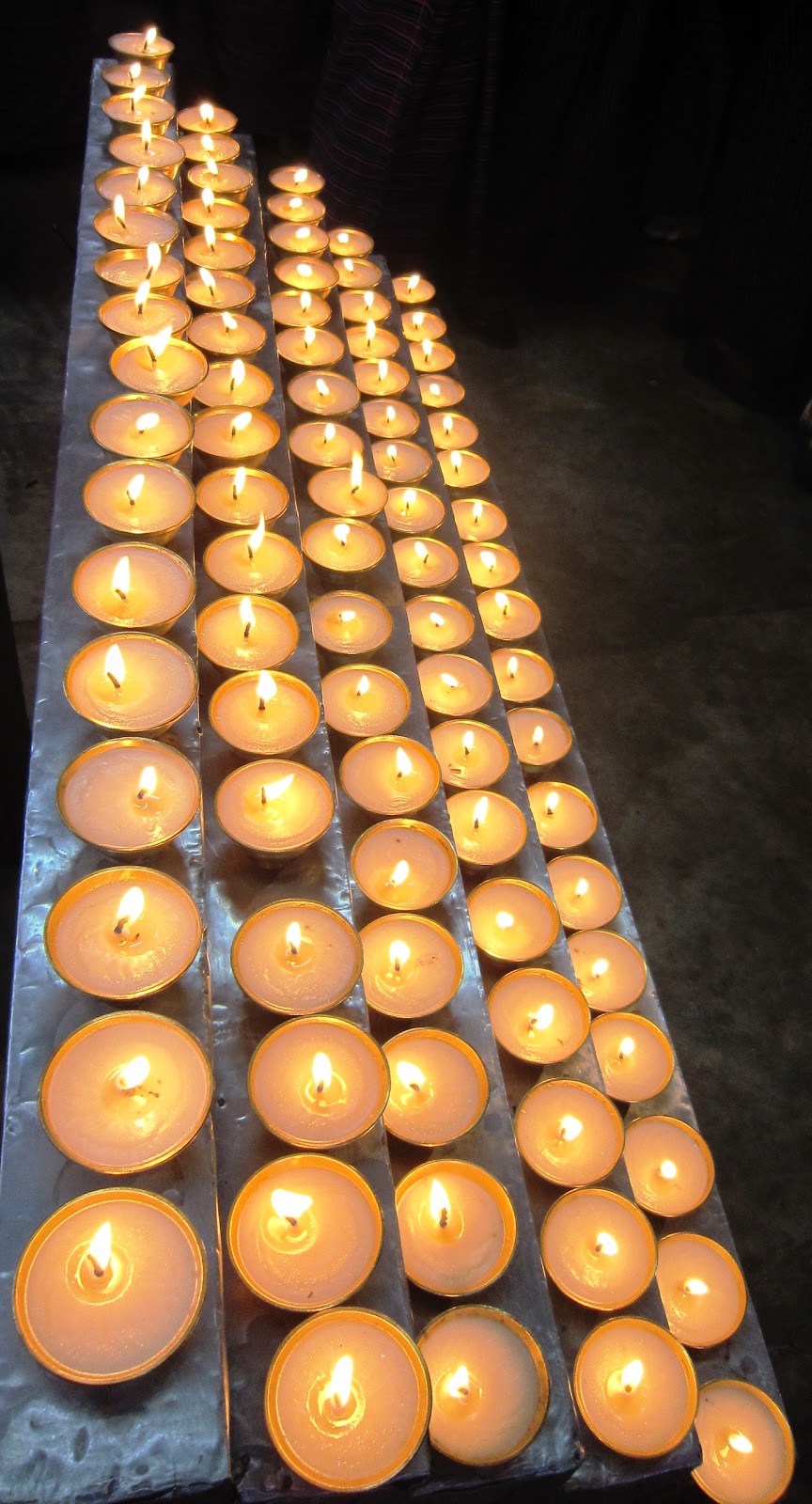
I dedicated these lamps to the unfortunate souls of 9/11
At 3 AM, a monk came to wake us and we woke up with much struggle. After our washing and pouring, we went to the retreat hall. The monks were on the summer retreat (yaer-ney) for one and half months. The retreat hall was mainly used for the discourse, presentations, and debates. In the morning, the programme was scheduled for taking the vows for the day and some recitations. The morning programme lasted until 7 AM. Then, we went to light butter lamps and I dedicated the offerings to the departed souls of 9/11/2001 and all sentient beings. We had our breakfast after that and we were free till 11 AM.
The Library
I had nothing in mind than to rush back to the guest room and take a sound nap. But, my nap lasted for a very short time. I was up by 9.30 AM.  Then, we went for a campus tour. The monastery does have a beautiful environment. Flowers were plenty with different butterflies and bees hovering around. The lawn was also maintained well with fresh and well-trimmed grasses.  I began to click at anything I saw.
Monks entering the retreat hall in the Main Lhakang
At 1O AM, we had tea which was sponsored by our group (our group includes most staff from Samtengang MSS). After that, it was again campus tour. This time, we found the Monastery shop. Monks ran it and the rates were subsidized rates and I found the practice an exemplary one.
After the blessing programmee
We were then called to gather in the retreat hall at 11 AM. It was the time for religious discourse by the Principal of the Shedra. We were fortunate to receive the teachings of the Buddha and also the presence of two truelkus (Reincarnation of revered lamas) added more air. One was the reincarnation of the 69th Je Khenpo (head abbot of the monk body) and the other was Rechung truelku. We received blessings. As of the discourse, it was on how we should ask pardon (shag pa) for our sins. If put simply, the Lama spoke on the following- We commit sins as we live our lives but we should beg for pardon; and it is very important to do so.  We should, with full dedication, offer our pledge and ask for forgiveness. The lama touched on how human beings commit different crimes. He even narrated related stories. One particular story I liked was that of King Asoka. According to the story, Asoka was not a Buddhist initially and was always committing sins. In one case, he was told to kill 1000 people to attain enlightenment. So, Asoka build a temple for the purpose and appointed a man to lure visitors into the temple and kill them. The murderer, appointed by Asoka, was successful and the number he killed reached 500. When he reached the above number, a Buddhist monk accidentally reached Asoka’s temple. He begged for a week’s time when the man in-charge tried to kill him. The monk was so afraid that he meditated very strictly for the week. At the end of the agreed week, he was rewarded with supernatural power. Then he went to the man who he was to kill him and asked him to kill him. The man started a big fire, put a big frying pan over it, and heated the pan till it turned red hot. The man then lifted the monk and threw him into the burning pan.  But, the monk flew out every time the man threw him into the pan. The man was shocked and reported to Asoka. Asoka talked to the monk on how he did the miraculous thing. Upon some answers, Asoka knew that the monk was a Buddhist monk. Then, Asoka stopped his killing spree and converted himself and his subjects to Buddhism. This is how Asoka became a great Buddhist king.The discourse lasted for an hour.

It was blessings time after the discourse. All the sponsors (Jin-das in Dzongkha) were called in and blessed by the words of the revered ones. We were also awarded scarves (khaddar). It was some clicks with the scarf and then off to lunch.  The lunch was a vegetarian one but it was very scrumptious. It is believed that food at monasteries are blessed and are always delicious. I began to agree with this belief.
After lunch, we made ourselves ready for the return journey. A tractor was there to reach us to Tashi La. The ride on the tractor was fun, especially to Mr. Carson who was travelling in a tractor for the first time. The bumps nearly made us pour out our delicious lunch. It took us an hour to reach Tashi la.
Then it was again a cable ride. My friends were more confident as it was their second one. The most interesting thing that happened on the return flight was when we could see the scenery below at the highest point of the ropeway’s trail. The area was full of mist or cloud when we were going up. Carson was amazed to see the height though he has climbed skyscrapers taller than this. The ropeway takes 30 minutes to cover the area. We were tired and satisfied when we started our engine and began the rough road to Samtengang. 

INFORMATION ON THE MONASTERY, SUMMER RETREAT AND THE ROPE WAY

THE  SHEDRA

Rinchenling shedra is a government monastic school with 250 plus monks. The monastery is about 12 years old. The place Rinchenling is one of the 8 'Lings' in Bhutan. 'Lings' are associated with the great scholar Kuenkhen Longche Rabjam who spread the teachings of Buddha on a great scale in Bhutan. He founded eight places and each place he founded and blessed has the 'Ling' added to at the end of the place's name. Some 'Lings in Bhutan are Tharpaling in Bumthang, Kuenzangling in Wangdue and 6 more including the shedra.
The shedra is built in the typical Bhutanese style of monastery but it is equipped with all modern fecilities like electricity, geysers, phones etc. The place is a heaven on earth with surroundings full of flowers and without any litters seen around. The lawn is of international standard and is a treat to the eyes. The buildings are grand with beautiful Bhutanese paintings. There is one main building which acts as hostel  for the monks and quarters for the lopens aka teachers. The main lhakang/temple is three storied. The ground floor acts as retreat hall, debate hall, discourse hall etc. There are three main statues in the ground floor- we can be fortunate to view and get blessed by the Buddha statue in the center, zhabdrung and Guru on the two sides.  The temple of the founding lama is on the second floor. Below the lhakang, we see the beautil one storied library. There is also a small cottage where the reincarnation of the 69th Je Khenpo reside. The monks enjoy themselves with volleyball and movie shows in the dinning room, during off hours.One would enjoy to visit such a place for pilgrimage as you can feel the air of sacredness when you are in the area. And, it is obviously a great place for monks to learn and practice.  Visit yourself and be blessed. The valley is also an enchanting one to get a break from your everyday lives.

THE SUMMER RETREAT
The retreat is locally known as Yaer ney  which means summer hermitage. Monks do this retreat for a month and half where they do intensive studies. They are not allowed to travel outside the fences during the same. Monks also sacrifice dinner during the retreat. Senior monks do presentations and debate everyday. I found out that the retreat is a practice passed down since the time of Buddha.
I am sorry as I don't have the capacity to explain further.

THE ROPEWAY

The other box traveling on its path
I don't really know for how long the cable has been there but I know that it was initially installed to serve logging purpose. It looks very scary when one views people travel in it but you would enjoy if you get in to ride the only passenger carrying ropeway. The aerial views of the changing vegetation, yonder valleys, paddy fields, animals, water falls, cliffs, farm houses, people and other views are views of a life time.  The ropeway is situated at Chuzomsa, 9KM from Wangdue town. You have to pay Nu.150 to get a ride and will take half hour to cover the distance, which is abot 6KM long. The cable car carries passengers at 8 AM in the morning and 4 PM in the evening. When it is not passenger time, it serves to transport logs from Khtokha coup and also transports potatoes and other loads for the villagers. Everybody fears that one might fall into an accident when you travel by the ropeway but it is quite safe to travel. There is no history of human casuality in the history of the machine. There were some cases when passengers got stranded for some time (a woman stayed stranded for a night and to my knowledge, she holds the record of staying stranded). If you visit the Shedra in winter, you can drive up the 20 plus farm road but you have no other choice in summer, unless you love to hike uphill for 4 hours.


taking a tour


Me too

Paddy fields as viewed from the ropeway


In the box and on air...


The cables disappear in the thick mist


Clicking all the way

The road, the river, the paddy fields from the cable


On the highest point- nothing but the sound of the pulleys and fog/mist/cloud, god knows

Nothing... and nothing...


Enhanced by Zemanta

OFFERINGS

These butter lamps were lit in the name of the departed souls of 9/11

Friday, September 9, 2011

The Bard of Avon


Shakespeare. W (source: Google image search)
It may be an absurd idea for some to highlight on this topic as Shakespearean drama is no longer studied in Bhutan. This does not mean that we should forget the great dramatist. Personally, I feel that our students are less fortunate as they do not have the privilege to study Shakespearean drama. I think we have lost a gem too soon. Never the less, I have decided to throw some light on this great dramatist.
William Shakespeare born in 1564 was an English poet and playwright, widely regarded as the greatest writer in the English language and the world's most eminent dramatist. He is often called England's national poet and the "Bard of Avon". His surviving works consist of 38 plays 154 sonnets, two long narrative poems, and several other poems. His plays have been translated into every major living language and are performed more often than those of any other playwright are.
Shakespeare was born and raised in Stafford-upon-Avon in the United Kingdom. At the age of 18 he married Anne Hathaway, who bore him three children: Susanna, and twins Hamnet and Judith. Between 1585 and 1592, he began a successful career in London as an actor, writer, and part owner of the playing company the Lord Chamberlain's Men. He appears to have retired to Stafford around 1613, where he died three years later. Shakespeare produced most of his known work between 1590 and 1613. His early plays were mainly comedies and histories, genres he raised to the peak of sophistication and artistry by the end of the sixteenth century. Next he wrote mainly tragedies until about 1608, including Hamlet, King Lear, and Macbeth, considered some of the finest examples in the English language. In his last phase, he wrote tragicomedies and collaborated with other playwrights. Many of his plays were published in editions of varying quality and accuracy during his lifetime.
Shakespeare was a respected poet and playwright in his own day, but his reputation did not rise to its present heights until the nineteenth century. His plays remain highly popular today and are consistently performed and reinterpreted in diverse cultural and political contexts throughout the world.
Shakespeare's work has made a lasting impression on later theatre and literature. In particular, he expanded the dramatic potential of characterization, plot, language, and genre. Until Romeo and Juliet, for example, romance had not been viewed as a worthy topic for tragedy. Soliloquies had been used mainly to convey information about characters or events; but Shakespeare used them to explore characters' minds. His work heavily influenced later poetry. The Romantic poets attempted to revive Shakespearean verse drama, though with little success.
Shakespeare influenced novelists such as Thomas Hardy, William Faulkner, and Charles Dickens. Dickens often quoted Shakespeare, drawing 25 of his titles from Shakespeare's works. The American novelist Herman Melville's soliloquies owe much to Shakespeare; his Captain Ahab in Moby Dick is a classic tragic hero, inspired by King Lear. Scholars have identified 20,000 pieces of music linked to Shakespeare's works. These include two operas by Giuseppe Verdi, Othello and Falstaff, whose critical standing compares with that of the source plays. Shakespeare has also inspired many painters, including the Romantics.
In Shakespeare's day, English grammar and spelling were less standardised than they are now, and his use of language helped shape modern English. Samuel Johnson quoted him more often than any other author in his A Dictionary of the English Language, the first serious work of its type. Expressions such as "with bated breath" (Merchant of Venice) and "a foregone conclusion" (Othello) have found their way into everyday English speech.
Overall, Shakespeare contributed more than 5000 words to the English language and his works are all above mere admiration. He is a figure that cannot be denied while we talk about English language.
  I am forced to conclude here, as it will take ages to highlight all the greatness of this great dramatist. Ben Jonson on Shakespeare: He was not of an age, but for all times.
  I urge all to read Shakespearean literature and feel the thirst quenched.

Some ideas were borrowed from www.wikipedia.org/shakespeare


College Humour


     I was in the first year and it was just a week in the college. I was reading the notice outside my class. Suddenly a tall and huge man came and started reading the notice. I took the man for a lecturer and moved aside as a sign of respect. The same day as I was going for lunch I saw the same man with a plate and a mug, rushing towards the mess. To my surprise he was also a trainee and was going for lunch too. So guys be careful.

Saturday, September 3, 2011

"CHOE-SHED LAERIM"- The Religious Discourse


3rd September, Samtengang MSS.  A Choeshed lerim aka Religious discourse was organised by the Choethuen Tshokpa  or The Religious Committee of the school. Simply put, the main focus of the day was on the correction and proper maintenance of our thoughts/mind.  We had Lopen Lhatu, a senior monk and a lopen (teacher), from Wangdue monastery. It was a part of the tshokpa's  annual programmee.

I confess that I am not so much into religion but this  state of mine  was challenged to its end today. So, I am here with news, knowledge acquired... and prayers.

The discourse started with recitation of Tashi Tsegpa and Jampelyang Soeldep.  It was so humble of the Lama to thank the school for giving him a platform to pass the virtues of the Buddha. Then, he outlined the day's aims and the areas that were to be covered.

During the program, he focused on two things- The Bodhisattva way of thinking and  the way to virtous living. In the process of the discourse, the lama was so eloquent in his discourse that the floor listened without a wink. He had a great way of getting his messages to the listeners. As a preacher, he used harsh realities and jokes to keep the audience vibrant.  We were taught how to think like a Bodhisattva. And also, we were exposed to the vice and virtues and asked to choose the virtues. The way he explained about the rarity of being born as a human being really opened our inner eyes and gripped our senses. We are lucky to be born as human beings and we need to live good human. One simple thing the lama talked of was that we need not become monks or nuns to live the Bodhisattva way; we can control our thoughts and divert them to doing virtuous and valuable things. I think we know this simple truth but we are so lost in the world of lust, love, hatred, jealousy, envy, wrath.  The most interesting part I liked was the way he explained the pain that parents take for the well being of their children. The lama narrated as if he suffered all the pains that a parent does. I was stunned to see the depth in which he knew about the mundane world (He is a monk and has very less experience of the mundane world) Students and teachers pledged to follow the way of the Bodhisattva and only the almighty knows how many will keep the promise.

My Views...and pledge...


The path of the Bodhisattva is very difficult to live if you are enveloped with the excitement and joys of the mundane world but it is very simple if you can control your thoughts. Try to divert your thoughts and deeds to doing something useful and valuable. It's quite simple. Lets view it like this- We are putting our hands in a big bag, full of different things; if you pick something valuable, keep it and if your hands are pricked by a thorn or something invaluable, throw it away.  The bag which is full of different things can be compared to our different thoughts;  the valuable things you keep from the bag are the moral thoughts we have to think and the invaluable things are the immoral  thoughts like Lust, jealousy etc,  that we need to drain out from our mind. An average human runs more than 60000 thoughts  in a day. Let us pledge today to divert our thoughts toward moral deeds  (or as many thoughts as we can). I am not a Bodhisattva and know nothing of the way of a Bodhisattva. Please pardon me if I have got anything wrong or misguided. Forgive me and thank me not if I made you to think twice before thinking a thought of- killing an irritating mosquito or eating a delicious chicken curry or  going against your parents or doing a deed that is against the say of the Buddha.

The programme concluded with question answer session and prayers for all sentient beings.

_____________________________________________________
Some questions were very important  and I think it will be wise and helpful of me to share what  was discussed.  (Pardon me if I am not able to put the contents in detail or clearly. I admit, I'm not a good translator)

Q1. A man kills insects/animals unknowingly. For instance, I kill an ant when I am walking, unknowingly and unintentionally. Juxtapose to this, a man kills an animal knowingly and with the intention to kill it. Is there a difference in the the amount of sin we accumulate?

Answer (As answered by the Lama): Both will surely accumulate sin but the amount and degree is different. There are three (actually the lama referred to four but I was not able to translate one in English but the three listed below cover all the four) different kinds in which we accumulate sin from killing according to the words of the enlightened one. They are as follows:
1. Intention of killing
2. Sin for the act of taking the life
3. Sin for the 'state of knowing' that you are taking a life (soow in dzongkha)

Thus, when we take a life unknowingly, we are bearing the sin for the act of taking the life only. And we accumulate all four when we kill something knowingly and with the intention.

Q2. An animal or any soul is about to perish but the state is such that the being is suffering a great deal of pain. Is it a sin to kill the animal with thought of reducing its pain? Is there a difference in the amount of sin?

Answer: There is sin, after all you are taking a life. It is also the same amount of sin as a butcher accumulates when he slaughters an animal. My suggestion is to help and nurse the particular animal as much as one can do.

Q3.  When you chant the mantra Om mani pedmay hung, Is it necessary to say the word Hri at the end of the mantra? Do we need to say Om mani pedmay hung hri?

Answer: It is not necessary to say the hri . We can just chant as Om mani pedmay hung.

Q4. A butcher slaughters animals and we eat the meat from the slaughtered animals. What is the difference in the sin? 

Answer: The butcher will suffer the sins we talked about but the one who eats the meat will share certain sins. The butcher kills because we eat meat. They are thriving because of our demand. I think you now know how to weigh the amount of sin.

Q5. Is there a pardon if we realise our mistakes and vow to stop doing the same things?


Answer: To this I'll narrate the story of Gey she (revered lama) Beaan. Beaan was a robber who killed and robbed people. He didn't spare even  the horses. He never realised that he was traveling the evil path. Once, he attacked a traveler with a horse and her foal. He killed the man and then the mare. When he was about to leave the place, he saw a very unusual thing; the dying mare struggled herself to the foal, licked her with eyes full of tears and the mare breathed her last breath, died with her head on the foals neck. Instantly, Beaan threw away his tools, the loot and cried. He was sticken with grief and despair. Then and there, he decided to ask for pardon and the only way was to live the life of a monk. So, he left and became a monk. he was pardoned of his past deeds and became a revered lama.
___________________________________________________

May all sentient beings be deprived of the evil thought and be released from the sufferings of the samsara. 


Enhanced by Zemanta